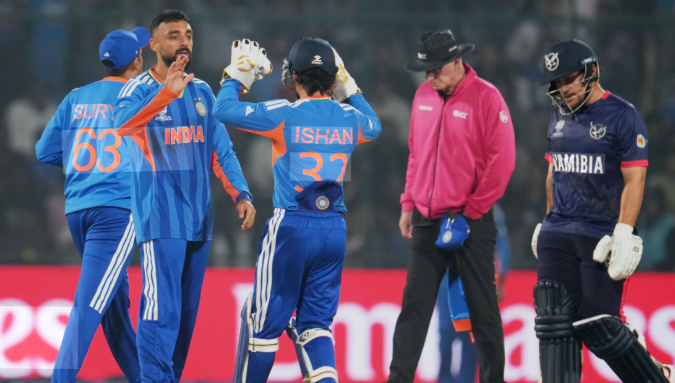
The cricketing timeline between the India National Cricket Team and the Namibia National Cricket Team may seem brief, but it carries a deeper narrative of contrast, ambition, and evolution. From their first meeting in the 2003 World Cup to their T20 clash in 2021, these encounters reveal more than just scorecards. They highlight the gap between a global powerhouse and a rising associate nation. Yet within that gap lies a story of growth, resilience, and changing dynamics. Each match reflects not only performance but also the broader journey of cricket as it expands beyond its traditional strongholds.
Recent Matches: India vs Namibia
Date
Tournament
Format
Winner
Margin
Top Performer
12 Feb 2026
ICC T20 World Cup
T20I
India
93 Runs
Hardik Pandya (52 & 2/21)
08 Nov 2021
ICC T20 World Cup
T20I
India
9 Wickets
Rohit Sharma (56)
23 Feb 2003
ICC World Cup
ODI
India
181 Runs
Sachin Tendulkar (152*)
Top 5 All-Time Best Performances
Rank
Player
Performance
Match Date
Impact Summary
1
Sachin Tendulkar
152 (151 balls)*
23 Feb 2003
The highest-ever individual score in this fixture; a legendary ODI World Cup century.
2
Sourav Ganguly
112 (119 balls)*
23 Feb 2003
Partnered with Sachin for a record 244-run stand that completely deflated Namibia.
3
Ishan Kishan
53 (21 balls)
12 Feb 2026
Set the tone in the 2026 T20WC with the fastest-ever Powerplay fifty against Namibia.
4
Gerhard Erasmus
4/20 (4 Overs)
12 Feb 2026
The best-ever bowling performance by a Namibian against India, stalling a 220+ total.
5
Varun Chakravarthy
3/7 (4 Overs)
12 Feb 2026
A masterclass in spin that choked the Namibian chase, maintaining an economy of just 1.75.
Best Player Performance Analysis
Player Name
Team
Match Impact
Best Score/Stat
Role & Style
Sachin Tendulkar
India
High (2003 WC)
152* (151 balls)
Aggressive Opener
Sourav Ganguly
India
High (2003 WC)
112* (119 balls)
Tactical Middle Order
Hardik Pandya
India
High (2026 T20WC)
52 Runs & 2 Wkts
Dynamic All-Rounder
Ishan Kishan
India
High (2026 T20WC)
61 Runs (30 balls)
Power-Hitter (WK)
Rohit Sharma
India
High (2021 T20WC)
56 Runs (37 balls)
Strategic Captain
Gerhard Erasmus
Namibia
High (All Formats)
4/20 & 32 Runs
Inspirational Leader
A First Meeting That Felt Like a Mismatch
When the India National Cricket Team first crossed paths with the Namibia National Cricket Team, the contrast was impossible to ignore. One side carried decades of international dominance, while the other stepped onto the global stage still learning its rhythm. The 2003 World Cup encounter felt less like a rivalry and more like a test of survival for Namibia. India’s batting depth, led by experienced names, set an imposing tone early. Namibia showed flashes of courage, refusing to fold under pressure, but the gap in experience dictated the flow. For fans, it was a glimpse into cricket’s uneven landscape, where ambition met reality on the biggest stage.
Season
Score
Winning Team
Key Performance
Match Context
2003 World Cup
India 311 2
India
Sachin Tendulkar steady start, Sourav Ganguly century
Group stage dominance
2003 World Cup
Namibia 130 all out
India
Zaheer Khan early breakthroughs
Namibia struggled in chase
2003 World Cup
Match Result
India won by 181 runs
Strong all round team effort
Clear gap in experience
2003 World Cup
Overall Impact
India dominant
Namibia gained exposure
Start of rare rivalry
The 2003 World Cup Clash That Introduced the Rivalry
The 2003 World Cup meeting between the India National Cricket Team and the Namibia National Cricket Team was more than just a group stage game. It marked Namibia’s arrival on the biggest stage against a cricket giant. India batted with authority, piling up a massive total powered by a brilliant century from Sourav Ganguly and strong support from Sachin Tendulkar. Namibia entered the chase with hope but soon felt the pressure of disciplined Indian bowling. Despite a few brave moments, wickets fell quickly. The result was one sided, yet the match planted the first seed of a rare international cricket connection between two vastly different teams.
Season
Score
Winning Team
Key Performance
Match Insight
2003 World Cup
India 311 2
India
Sourav Ganguly 112 runs
Dominant batting display
2003 World Cup
Namibia 130 all out
India
Zaheer Khan 2 wickets
Early collapse in chase
2003 World Cup
Result
India won by 181 runs
Team effort
Huge gap in quality
2003 World Cup
Overall Impact
India dominant
Namibia gained experience
Start of rivalry story
2021 T20 World Cup Face Off Under Pressure
The 2021 T20 World Cup clash between the India National Cricket Team and the Namibia National Cricket Team came with unexpected pressure. India, already out of semifinal contention, played for pride, while Namibia aimed to prove their growth on the global stage. Batting first, Namibia struggled against disciplined Indian bowling, posting a modest total. India approached the chase with calm authority as Rohit Sharma and KL Rahul dominated early. Their aggressive yet controlled partnership sealed the game quickly. Though the result was predictable, Namibia’s journey to this stage earned respect, making the contest more meaningful than the scoreline suggested.
Season
Score
Winning Team
Key Performance
Match Insight
2021 T20 World Cup
Namibia 132 8
India
Ravindra Jadeja 3 wickets
Tight bowling control
2021 T20 World Cup
India 136 0
India
KL Rahul 54 not out
Dominant chase
2021 T20 World Cup
Result
India won by 9 wickets
Rohit Sharma 56 runs
Easy finish
2021 T20 World Cup
Overall Impact
India strong finish
Namibia gained respect
Competitive spirit shown
Tactical Breakdown Across Matches
Across their rare encounters, the tactical contrast between the India National Cricket Team and the Namibia National Cricket Team has always been striking. India relied on depth and control, building innings patiently before accelerating, while their bowlers attacked with early breakthroughs and tight middle overs. In 2003, India used swing and disciplined lines to dismantle Namibia quickly. By 2021, their T20 approach shifted to aggressive powerplay batting and spin dominance through the middle. Namibia, on the other hand, focused on survival, rotating strike and targeting loose deliveries. Their bowlers attempted variations and defensive fields to contain runs, but lacked consistency under pressure, which often proved decisive.
Season
Batting Strategy
Bowling Plan
Winning Team
Key Tactical Insight
2003 World Cup
India built long innings with partnerships
Early pace attack with swing
India
Controlled dominance from start
2003 World Cup
Namibia cautious approach
Defensive lines and lengths
India
Struggled against pressure
2021 T20 World Cup
India aggressive powerplay batting
Spin choke in middle overs
India
Modern T20 dominance
2021 T20 World Cup
Namibia strike rotation focus
Variation based bowling
India
Could not sustain pressure
Fan Emotions, Expectations, and Reality
For supporters of the India National Cricket Team, matches against the Namibia National Cricket Team were never just about winning. They expected dominance, clean execution, and a statement performance. Anything less sparked debate. In contrast, Namibian fans watched with pride, knowing their team was sharing the field with one of cricket’s giants. The 2003 clash felt overwhelming, yet inspiring. By 2021, belief had grown, and every boundary or wicket drew loud celebration. Social media amplified these emotions, with Indian fans demanding perfection while Namibian supporters celebrated progress. In reality, the results reflected the gap in experience, but the emotional takeaway told a richer story of ambition, respect, and growing global competition.
Season
Fan Expectations
Match Result
Emotional Response
Reality Check
2003 World Cup
India expected easy win
India dominant win
India satisfied, Namibia hopeful
Clear gap in quality
2003 World Cup
Namibia aimed to compete
Heavy defeat
Pride despite loss
Learning experience
2021 T20 World Cup
India demanded strong finish
India won comfortably
Relief and mixed reactions
Too late for comeback
2021 T20 World Cup
Namibia sought respect
Competitive effort
Celebrated small moments
Growth visible
Defining Moments That Still Echo
Certain flashes from these encounters between the India National Cricket Team and the Namibia National Cricket Team have stayed alive far beyond the final scores. In 2003, the commanding century by Sourav Ganguly set the tone for total dominance, while Sachin Tendulkar provided the early control that crushed any hope of an upset. Years later in 2021, the effortless chase led by Rohit Sharma and KL Rahul showed how far T20 cricket had evolved. Yet, Namibia’s spirited fight in both matches quietly became their defining takeaway, proving that even in defeat, moments of courage can shape a team’s identity.
Season
Moment
Player Performance
Impact
Legacy
2003 World Cup
Big opening partnership
Sachin Tendulkar steady start
Set platform for huge score
Early control defined match
2003 World Cup
Match defining century
Sourav Ganguly 112 runs
Took game away completely
Symbol of dominance
2021 T20 World Cup
Explosive opening stand
Rohit Sharma and KL Rahul fifties
Quick chase finish
Modern T20 authority
2021 T20 World Cup
Namibia fighting spirit
Team effort
Earned global respect
Growth beyond result
What This Timeline Means for Cricket’s Bigger Picture
The journey between the India National Cricket Team and the Namibia National Cricket Team reflects more than just two matches. It highlights the evolving landscape of global cricket. India’s dominance shows the strength of established systems, deep talent pools, and high pressure experience. Namibia’s progress, though marked by defeats, represents the growing competitiveness of emerging nations. These encounters underline how exposure to top teams accelerates development. For the sport, such matchups are essential. They bridge the gap between tiers, inspire smaller cricketing nations, and push governing bodies to invest in global growth. The timeline is not just about results, but about cricket expanding beyond traditional boundaries.
Season
Cricket Context
Team Outcome
Key Learning
Global Impact
2003 World Cup
Early global expansion
India dominant
Gap in experience clear
Associate exposure began
2003 World Cup
Emerging nations struggle
Namibia defeat
Need for development
Growth pathways highlighted
2021 T20 World Cup
Modern T20 era
India strong win
Faster adaptation needed
Competitive gap narrowing
2021 T20 World Cup
Rising associate teams
Namibia improved
Value of global tournaments
Wider cricket reach
Conclusion
Looking back at the encounters between the India National Cricket Team and the Namibia National Cricket Team, the results may favor one side, but the impact goes far beyond wins and losses. India’s consistency reinforces its stature, while Namibia’s steady progress signals the rise of competitive spirit among emerging teams. These matches remind us that cricket is not just about dominance but also about opportunity and growth. As the sport continues to evolve, such timelines play a crucial role in shaping a more inclusive and competitive global cricketing future.